Management of local community issues
Without urgent action, the move to Unitary councils will mean many communities lose influence over hyper-local issues, including the management of many cherished local assets. In other areas of England many non-statutory services have been saved only where there are Town or Parish Councils to take them over.
Impact of creating Unitary Authorities
Experience elsewhere has shown that the creation of Unitary Authorities can lead to the withdrawal of discretionary services previously provided by the previous two-tier councils. Cornwall Council, for example, has stopped providing libraries, public toilets and leisure centres; in most cases, local residents still want these services and Civil Parishes (i.e. City, Town and Parish Councils) have taken them over. The result has been a substantial increase in the size and activities of Civil Parishes.
A similar pattern is being seen in Somerset. Since the Unitary Council was created in 2023, many Civil Parishes have taken on new services which local residents wanted to retain.
Before their Unitary Councils were created, both Cornwall and Somerset were almost entirely parished and both created new Town Councils to plug the gaps.
The role of Civil Parishes
Outside metropolitan areas, most parts of England have Civil Parishes, apart from areas where a District Council covers a single community, such as Crawley, Eastbourne and Hastings. Civil Parishes are a formal part of Local Government subject to formal elections and codes of conduct and in most cases having paid Clerks (albeit part-timers in smaller Parish Councils). They have the right to raise a precept, collected alongside residents’ Council Tax. Town Councils and larger Parish Councils often have their own workforce.
In rural areas, Parish Councils provide an important source of local knowledge, for instance to inform Planning Decisions and Highways issues, and fund some services, such as footpath maintenance and local playgrounds. In more urban areas, Town Councils often play a larger role, owning and running Community Centres, allotments and other cherished local assets.
See comparison of Civil Parishes with Informal Residents' Groups
Surrey's unique challenge
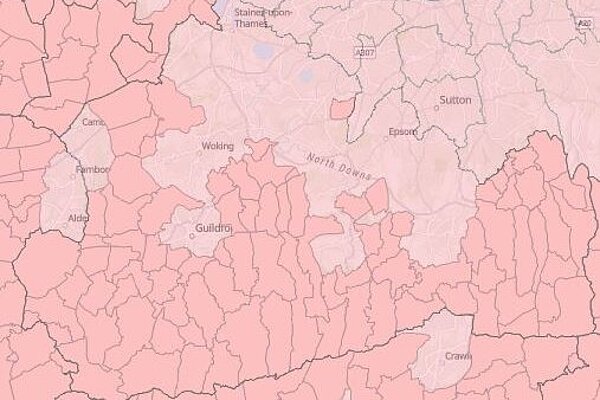
Surrey (including Mole Valley) is virtually unique in not following this pattern. The map shows areas with Civil Parishes shaded darker, demonstrating that most of the Northern part of Surrey is not parished, including major towns such as Guildford, Woking, Dorking, Leatherhead, Reigate, Redhill, Staines, Weybridge, Camberley & Chertsey. Mole Valley reflects this split with Parish Councils covering most of the rural villages, but most urban areas unparished.
When the two-tier councils disappear, residents without Civil Parishes will be less able to influence and manage their communities.
For instance Leatherhead residents were very concerned in 2012 when the Conservatives & Ashtead Independents running Mole Valley threatened a major development on Poors’ Allotments. Eventually this threat was removed with the new Local Plan agreed under the Liberal Democrats in 2024. However any community could face similar threats in future, especially if the Government increases pressure to build more homes.
Area Committees
Many existing Unitary authorities operate Area Committees – perhaps based on the previous council boundaries – and we support this approach. In some cases these are Committees of Councillors with delegated decision-making powers (such as deciding Planning Applications). In other cases they bring together councillors and representatives of other public services, such as health, police and fire services. But neither goes far enough.
With no powers to raise precepts, such Committees would be limited to activities budgeted for by the full Council - most likely to be one-off grants to support local initiatives. It is unclear whether they could commit on-going finance for discretionary services cut by the Unitary Council or to reflect local residents’ wishes to spend additional funding on an improved service in their community.
Surrey County Council has been operating four pilots of Neighbourhood Area Committees to provide some experience to pass on to the new Unitary Councils. Various local Lib Dems have engaged with these pilots. It has been publicly recognised that these Neighbourhood Area Committees are intended to operate alongside Parish and Town Councils.
The Government's position
The Government’s Devolution White Paper stressed the importance of managing cherished community assets and managing “hyper-local” issues. The Government promised to “re-wire” the relationship of Civil Parishes with other Councils.
However while they are calling for improved models of local governance, the Government's intentions here are unclear.
Summary
As things stand, the creation of Unitary Councils in Surrey presents a potential risk to discretionary services such as libraries, leisure centres, allotment and public toilets. The aggressive timetable requested by the Conservative Leader of Surrey County Council and then imposed by the Government will make it very difficult to create alternative accountable bodies to take over these services.
Moreover the move to Unitary Authorities risks exacerbating the discrepancies between areas where residents pay an additional precept to a Parish Council and those where equivalent services are provided by the County or District.
Many District and Borough Councils have responded to this threat by initiating a Community Governance Review (CGR) – the process which could allow the creation of new Civil Parishes before the Unitary Authorities are formed. In the East Surrey area, only Elmbridge has not initiated a CGR.
The Mole Valley CGR is moving into a critical phase as the final consultation is undertaken on the proposals from the Council.